Kiwi brewers are frustrated at the political inaction that’s leaves them at a huge disadvantage when selling their beer in Australia.
Australian breweries get a $400,000-a-year excise tax rebate and New Zealand breweries argue they should get the same relief under the rules of the Closer Economic Relations (CER) — the long-standing free trade deal between the trans-Tasman neighbours.
CER creates an effective common market between New Zealand and Australia but in the case of breweries and spirit producers the playing field is nowhere near level and they cannot get any traction with the Australian government.
Garage Project are one of the hardest hit, noting that since they began self-distributing in Australia, they have paid more than A$2 million in effective tariffs.
“This limits our ability to invest in the Australian market, it limits our ability to employ more people and it limits our ability to compete — it’s far from the level playing field we’ve been promised under CER,” the brewery posted to social media.
“We’ve been doing our best to lobby our politicians to do their job, but five years on we’re still waiting — and every month it remains unresolved makes a huge difference to us. It’s time someone picked up the phone and got this sorted.”
Annoyingly for brewers and spirit producers, NZ wine exporters do get an equal playing field with their Australian counterparts in this regard.
The situation prompted the Ministry for Foreign Affairs and Trade (MFAT) to commission a report into the matter entitled “Economic Impacts of New Zealand Exporters Being Excluded from Australia’s Excise Remissions Scheme”.
The report, released under the Official Information Act, is clear: New Zealand breweries are paying a heavy price and it’s not helping the Australian industry either.
The report, created for MFAT by Sense Partners, puts some hard numbers on the problem: calculating that the excise exclusion is equivalent to Australia putting a tariff of between 23% and 38% on New Zealand craft beer, and around 55% on boutique spirits.
Garage Project’s numbers make the case starkly. A keg of its 8% ABV IPA Pernicious Weed costs around A$395 to land at an Australian bar — with roughly A$149 of that, or 38%, being excise tax. A comparable beer from a small Australian producer that qualifies for the remission scheme costs just A$196 to reach the same bar, less than half the price, because it pays no excise at all.
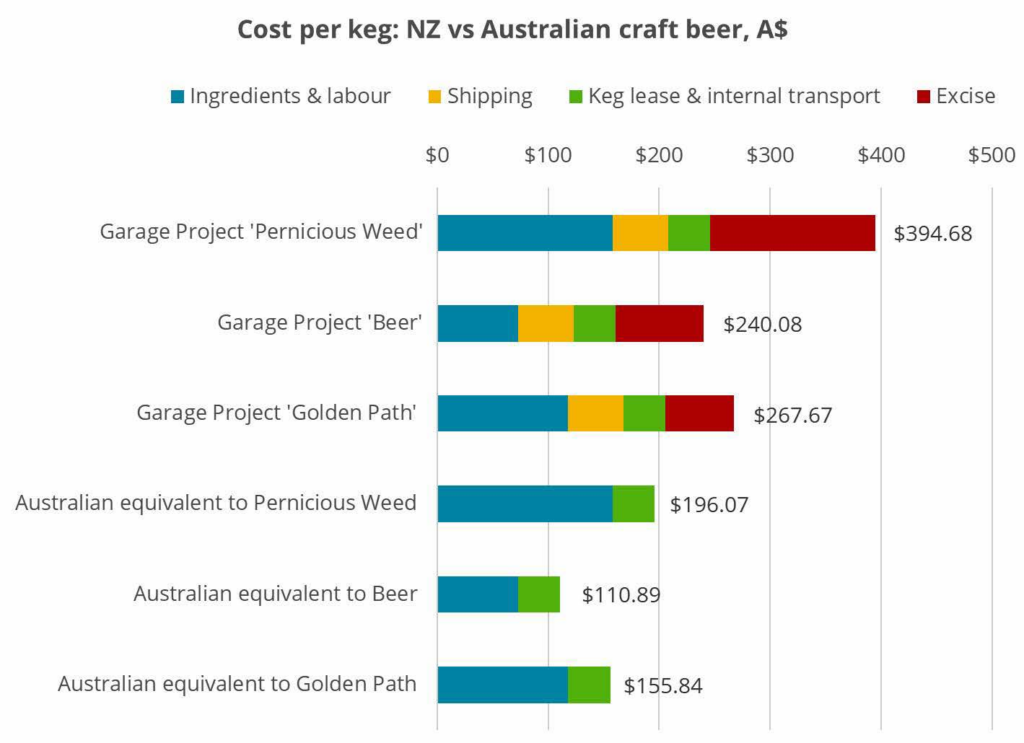
That cost gap has real consequences. The report says New Zealand’s trans-Tasman beer exports, which were growing at 3.2% a year before the scheme began in 2021, have since fallen by an average of 4.4% a year. Spirits exports, once growing more than 20% annually, have dropped by 8.4% per year since 2021 — a sharp reversal at odds with New Zealand’s total goods exports to Australia, which have kept growing solidly.
The report notes that it’s hard to separate out the impact of the scheme from the general post-Covid economic environment, but the fact that other New Zealand exporters are growing their trade with Australia in the same period does suggest that the excise tax rebate is hurting Kiwi breweries.
Brewers say the squeeze has forced hard choices. Survey respondents said the scheme has stalled trans-Tasman expansion plans, led to Australian staff layoffs, and pushed some exporters toward “riskier” markets in Asia. One brewer told researchers the excise burden, stacked on top of freight and higher New Zealand ingredient costs, had forced them into a “niche player” position in Australia — despite being the third-largest independently owned craft brewery in New Zealand.
Sense Partners estimates the exclusion has cost New Zealand between NZ$15.1 million and NZ$45.6 million in lost beer and spirits exports since 2021, translating to up to NZ$13 million in foregone GDP.
Curiously, the report argues fixing the tax gap would also benefit Australia. Bringing New Zealand exporters into the scheme would cost Australia’s government Less A$3 million a year in direct remissions — but the resulting lift in New Zealand exporters’ sales, advertising spend and excise payments would likely generate a net fiscal gain of up to A$8.5 million annually, alongside dozens of new Australian marketing and distribution jobs.
“The impact is real”
Jos Ruffell from Garage Project says the report is “stark”.
“It says the exclusion acts like an effective tariff on New Zealand craft beer and boutique spirits. It also makes the point that Australia is missing out too — less choice for consumers, less in-market spend, fewer jobs, and potentially less tax revenue than if New Zealand brewers and distillers were included.
“For Garage Project, the impact is very real. Since we began self-distributing in Australia, we’ve missed out on A$2.01m in relief that an equivalent Australian brewer could have accessed. And the perverse bit is that the policy pushes us towards looking at brewing in Australia to level the playing field, when the cleanest outcome would be to keep brewing in New Zealand and export fairly under CER.
“We’re not looking to attack Australian brewers. We support them getting relief. To be fair, the New Zealand Government has picked the issue up and raised it. But enough time has passed that we feel we can no longer keep this sitting quietly in the background.”
For their part, MFAT told me they’ve been working on this for over a decade and added:
- Most recently, the Prime Minister raised it with the Australian Prime Minister at the Australia New Zealand Leaders’ Meeting last month in Noosa. Despite these efforts, the Australian Government’s position has not changed.
- The Australian Government’s position is that the Scheme is limited to Australian producers.
- New Zealand successfully gained access to the Wine Equalisation Tax (WET) rebate following bilateral negotiations. The New Zealand Government has been engaged in a similar process for the past decade in respect to beer and spirits.
- The Ministry of Foreign Affairs and Trade are considering the Government’s options for resolving this issue.
On MFAT’s website they make mention of CER disputes, which this clearly is.
“Unlike other free trade agreements there is no formal dispute settlement mechanism in the CER. Though we may have our differences, through our spirit of mutual respect between our two governments, we are able to work through these differences to reach an outcome that is beneficial for all.”
At this point it seems Australia is not working through these differences and the outcome is definitely not beneficial for all: it’s actually beneficial to no-one.