There’s something magical in the water in Amberley, North Canterbury — and, as it turns out, the occasional mobile phone. After meeting Brew Moon co-owner Oscar McCauley at Beervana and visiting their taproom in September, we lined up a Sunday evening interview. Sunday came and went, but Oscar never rang. I gave him a few days’ grace; he had, after all, mentioned that a flash new canning machine was being installed and warned that, if it misbehaved, he might be a little grumpy. Fair enough. Still, no call.
A week later, a sheepish Oscar finally got in touch. Unbeknownst to him, his phone had slipped from his pocket into a stream as he walked from the brewery to his car. He found it four days later, lying in the riverbed and — despite the confluence of water and electronics — still intact.
This is the same bloke who, at the age of 10, wanting to help out at the newly founded family brewery, took his washing-and-scrubbing instructions a touch too enthusiastically, started an electrical fire, then attempted to put it out with — yes — water. A bold approach to both cleaning and conductivity.
Thankfully, water behaves much better in Brew Moon’s cracking range of beers, brewed in Amberley and poured across the wider Waipara Valley — home to more than 75 vineyards and, every now and then, a welcome palate reset in the form of beer.
What many drinkers may not realise is that Brew Moon is one of New Zealand’s oldest craft breweries — an achievement made even more remarkable by launching in rural New Zealand when loyalty to heavily marketed big-brewery brands was practically compulsory.
The Brew Moon story began in 1997, when Oscar’s parents, Belinda and Kieran, moved the family to California so Belinda could further her winemaking career. Their three years there placed them in the heart of the US West Coast craft-beer revolution, as breweries such as Lagunitas and Sierra Nevada grew beyond a mere foothold. Watching craft beer and hospitality come together in the brewpub model got the McCauleys wondering whether this might be the next big American idea to reach New Zealand.
Belinda could see some obvious parallels between wine and beer — fermentation being the main one — but once the commitment was made, reality arrived with a full pint. Brewing and hospitality both came with steep learning curves, so the family rolled up its sleeves and launched Brew Moon in their small rural hometown of Amberley. Oscar did his best not to burn the place down; the hand-labelling machine became his safe station, much to his parents’ relief.
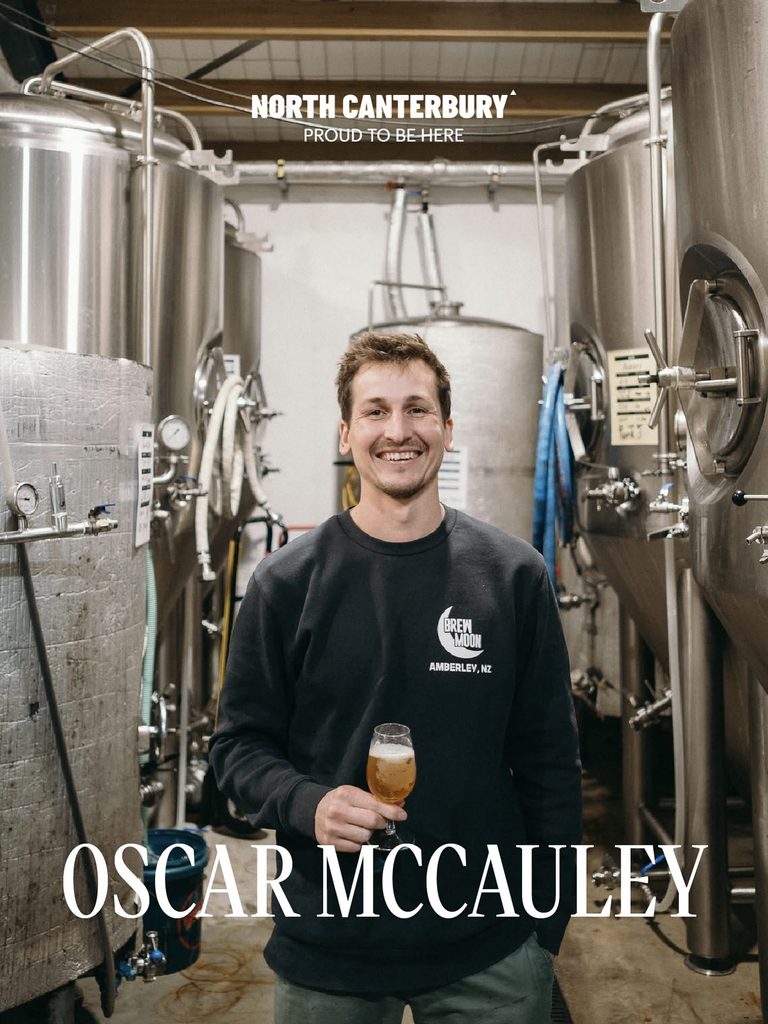
As for the name, memories are a little hazy but the idea was a play on Blue Moon: in the wine country of the Waipara Valley, you could find a beer only once in a blue moon. With the original site on State Highway 1, the name “Flat Possum Tavern” also received serious consideration. Brew Moon was, unquestionably, the tidier choice.
Brew Moon launched with four core beers. Contrary to the cliché of hard-case farmers welded to mainstream draught, the Waipara Valley had a surprisingly sizeable group of discerning drinkers aged over 50 who were keen to put their taste buds to work. Rather than play safe with a lager, the brewery came out in bottles and kegs with a pale ale, an IPA, a brown ale and a creamy stout — an adventurous shout for both the era and the postcode. The early going was tough, and with big breweries still controlling most local taps, the taproom became the focus. Locals quickly took to beer served fresh on site.
Sales spread through the valley via Belinda’s wine connections, with many cellar doors deciding that even wine country occasionally needs a beer.
The hours were long and the margins tight, and at one point selling the business was seriously considered. Kieran started to step back from the day to day running, Belinda swapped fresh water for salt water, beer for fish, and began eyeing retirement via a boat purchase. Meanwhile, Oscar’s brother Toby discovered there was more money underground in African mining. Oscar, meanwhile, was juggling chef rotations and staff rosters — a skill in itself, but far removed from brewing beer.
Enter Rod Thomson and Maty Johns, from Christchurch’s four-venue Base Woodfired Pizza company. Already an industry friend, Rod hauled his truck out from the city when Brew Moon’s wood-fired pizza operation packed a sad, parking up to save the day (or week as it turned out). Fast-forward, and the partnership now extends to part-ownership: with Rod and Maty bringing valuable hospitality and kitchen experience, freeing the McCauleys to concentrate on what goes in the glass.
Brew Moon may be humble, but it has always been a quiet pioneer. In 2015 it bought a canning machine. Around the same time, market leader Garage Project did likewise, helping create a bow wave of changing attitudes towards canned craft beer, which until then had been considered deeply uncool. Brew Moon also moved to a newer site.
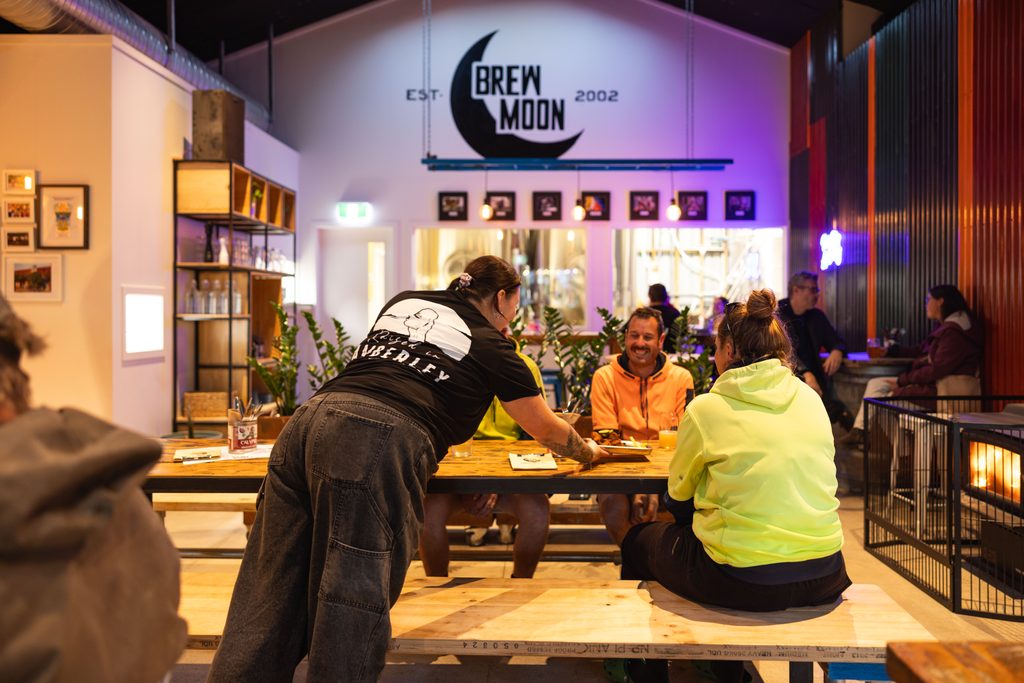
Amberley itself has been growing. After the earthquakes, people drifted north, while the wider valley’s wine industry brought both new residents and tourists — many of whom sensibly finish a wine tour with a beer and burger at Brew Moon.
Christchurch is the golden goose these days with 90% of sales in the city. One important stop on the way is Rangiora’s legendary Good Drop Craft Beer Bar, run by Dave Wilmott. Brew Moon is in such demand there that its beers regularly occupy up to a third of the taps.
Two years ago, the team decided to enlarge the venue. The outdoor area was already a cracker, but indoors there was room for only 25 to 30 people. The expansion lifted that to 80, giving midwinter trade a welcome boost and customers somewhere warmer than a puffer jacket. It is a delightful venue: rustic, comfortable, warm, relaxed and authentic, with friendly, knowledgeable staff. On the night we visited, it was humming — comfortably full, with locals steadily arriving to dine in or collect takeaway pizza and beer.
At about the same time came another breakthrough: selection for 2024 New World’s Top 30 brought nationwide distribution. That has been followed by the new canning machine — installed successfully, with Oscar reportedly not grumpy. It is faster, wastes less beer, protects the product, requires less labour and runs at two to three times the previous speed, while also producing 440ml cans for the first time. More beer, less waste: the sort of maths everyone can get behind.
So, there is plenty happening in the once-quiet town of Amberley, as well as plans afoot for a second brewpub in Halswell. With little presence in the South-west of Christchurch, the team see the new venue as a way to protect the loyal following they have built in the city and its northwest, while reaching a fresh neighbourhood. An 800-litre brewing unit will support experimental releases as well as extra volume for the usual summer surge — because nothing tests production planning quite like Canterbury sunshine and an empty pint.