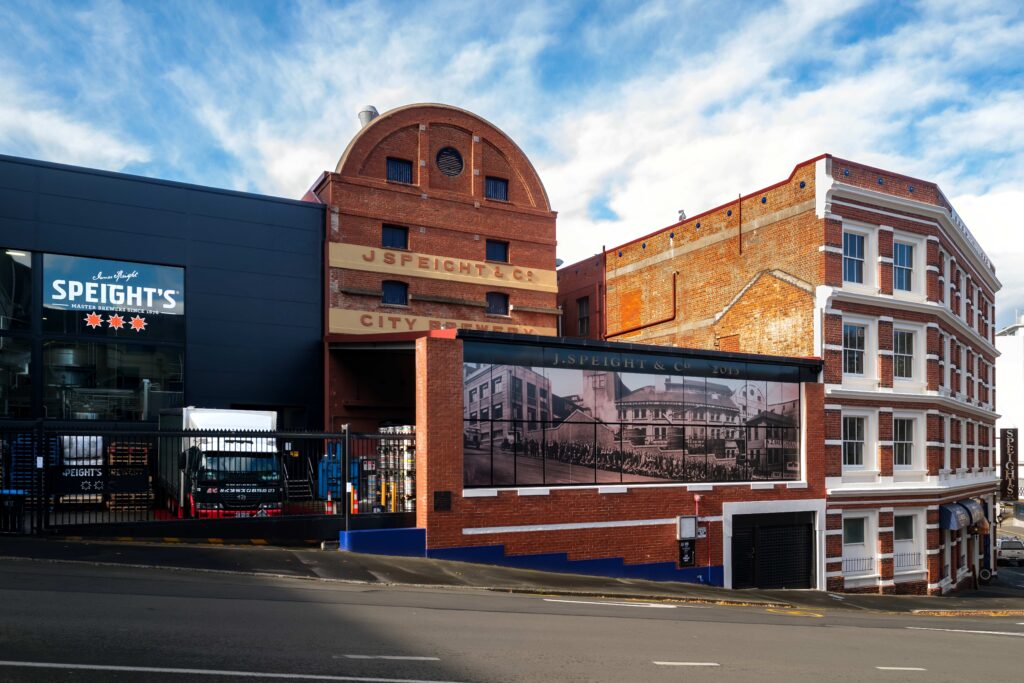
Speight’s Brewery in Dunedin — New Zealand’s oldest brewery — is celebrating its 150th birthday.
It’s quite the yarn, because it’s a brewery that has risen, fallen, partly revived, fallen, risen and risen further.
In celebrating the landmark birthday, owner Lion noted that 1 in 5 beers sold nationwide is from Speight’s. That’s almost totally due to the success of Speight’s Summit Ultra, the low carb beer launched in 2017 that is now New Zealand’s biggest selling beer.
Lion chief operating officer Craig Baldie says brand that continually moved with the times.
“Speight’s is New Zealand’s oldest brewery and is still operating at its original Rattray Street site in Dunedin. Over the past 150 years, the brand has continued to evolve in response to changing consumer preferences while remaining true to what people know and trust about Speight’s. That authenticity which is anchored in its southern values has enabled the brand to connect with New Zealanders over generations,” he said.
Speight’s Summit Ultra was developed to meet a growing demand for lower-carb options.
“We identified early that consumers overseas were looking for lighter styles of beer that aligned with more balanced lifestyles, without compromising on taste,” says Baldie.
“Summit Ultra has been instrumental in reshaping the brand’s trajectory and has played a significant role in its recent growth.”
It’s not the first time Speight’s has been the most popular beer in the country — that was the case 100 years ago, when the original Speight’s dominated sales, to the point where the brewery owned its own cargo ship to freight the beer to the North Island.
In his 1965 The Froth-Blower’s Manual beer writer Pat Lawlor waxed lyrical about pre-war Speight’s.
He described it as bitter, austere, “mighty and mystic”, with a strong hop character. Kiwis, he claimed, were bitterly divided about Speight’s mainly because of, well, its bitterness – you either drank Speight’s or you didn’t. Lawlor said it was so strong and bitter that he was forced to turn it into a shandy to make it palatable the first time he faced it. Gradually he came to love its “stern and solid” qualities and described it as “3-D”.
But it changed over the years, especially with the legislated reduction in alcohol during World War Two, and Lawlor claimed the “new Speight’s” was not a patch on the original. “No-one who has drunk old-time Speight’s can ever forget it. I know of New Zealand exiles now in Australia and further abroad who still think of the land of their birth in one word only – Speight’s.”
The fall and rise again of Speight’s
The WWII rationing of grain that reduced ABV on all beer had a marked effect on Speight’s — the beer changed and as a result of lower alcohol and hops it didn’t travel as well and sales dropped by a whopping 75%.
The brewery retreated to becoming and Otago-Southland brand and by the 1980s it was in danger of being closed when Doug Myers took over Lion and started to rationalise the business, continuing the post-war practice of closing regional breweries.
“We just shut breweries – it was a bit of a draconian way,” Myers told me many years ago, adding that Speight’s was in danger of going on the scrap heap as well “because it was a bit feral. But we left it open, more for PR purposes . . . it turned out to be quite a good decision!”
At that point Speight’s was simply the Dunedin branch of Lion Breweries and its revival was based on forging a separate identity from the corporate owner.
It started with an in-house competition to create a slogan that would inspire both the staff and the drinkers. The winner was Jackie Pepperkoon, whose slogan, “Follow the Stars”, was used for a while until someone had a brainwave and used second-placed Malcolm Campbell’s “Pride of the South” – a slogan that still appears on the label 40 years later.
A lot of things came together to make create a resurgent Speight’s — the success of the Otago rugby team in the 1980s being one. The other was the Southern Man ads.
Within months of Otago winning the national rugby title, beer advertising was allowed on television for the first time and Speight’s hit the jackpot almost straight away with the first of a series of ads featuring the late Frank Whitten, who would go on to find fame on Outrageous Fortune. It started, and probably didn’t get better than, the Perfect Girl ad.
It went something like this.
Old guy, young guy, out camping in Central Otago, horses, tussock, setting sun. Old guy has heard that young guy has met a new girlfriend who looks like a model.
Old guy says, “I hear you’ve been seeing a city girl.”
“Yep . . . She wants me to go to Auckland with her.”
“What’s the attraction up there?”
“Place on the harbour, 500SL Merc, 80-foot yacht, her old man’s got a box at Eden Park.”
“Oh yeah.”
“She doesn’t drink Speight’s but.”
“It’s a hard road finding the perfect woman, boy.”
“I reckon. Still, no hurry, eh.”
“Good on ya mate.”
In a post-sharemarket crash environment, says former Lion exec Danny Phillips, the “message was juxtaposing money and flashier, materialistic things – the pretty girl, the corporate box – against what really matters: a couple of guys having a beer, friendship, mates, something tangible and solid, and that did strike a chord with people. They went, ‘Right, that makes total sense, this stuff is fake and false on one hand and here’s a brand talking about what’s real and important and that makes me feel good, feel like I’ve got an anchor: that I can have a quiet beer with my mates and Speight’s is telling me that’s okay, that’s good.’ That’s the ultimate for a brand when it can help people navigate social complexities. It was a beacon of hope in the middle of this consumer-mad chaos. That was the core of Speight’s – stable, honest, a good bugger. Not larrikin, not party, not taking the piss, just honest New Zealand values that we all align to.” It was also about loyalty, with the young fella choosing his mates, and his beer, over “perfection”.
Sales picked up, prompting Myers to empower all his regional breweries to follow the same path towards independence. This resulted in the rebirth of regional brands such as Ward’s (repackaged as Canterbury Draught) and Waikato Draught, but they couldn’t rival Speight’s which became a dominant force, a force multiplied by the arrival of Summit Ultra.
How Speight’s began
Speight’s began with three men and a dream. The combination of a businessman, a maltster and a brewer was a can’t-miss trio. James Speight, the businessman who would give the brewery its name, actually started out as the minority shareholder when he, Charles Greenslade and William Dawson (future mayor of Dunedin) hooked up while working for Dunedin’s Well Park Brewery, the baby of James Wilson, who would go on to find fame with Wilson’s whisky.
Speight was a travelling salesman of beer (a fact that probably led to his death from cirrhosis of the liver at 53). Greenslade started life as a baker but soon crossed the grain divide to work as maltster. And Dawson, the youngster of the trio, was the son of a Scottish brewer. He studied at Burton-on-Trent, the home of British brewing. He landed in Port Chalmers stony-broke but immediately found a job at Well Park.
Their first brew was put down in April 1876, but it took four years of hard slog before business began to pick up (it was stiff competition in Dunedin in those days with around a dozen breweries operating in the city).
Speight’s big breakthrough came with winning two gold medals at a Melbourne show in 1880, which doubled sales. But what really pushed the company into the limelight was a decision by the Otago Daily Times to put the boot into the local beer by claiming it wasn’t as good as British beer, which was still being imported to New Zealand in large quantities. Speight’s wrote a letter in protest, noting its gold medal wins against the best beers on offer from Britain, Europe and the United States. When the ODT refused to publish the letter, Speight’s took out a massive advertisement in a rival newspaper, the Evening Star. Sales grew quickly, and for many years Speight’s continued to take out advertisements that simply stated how many awards it had picked up or quoted plaudits; at the 1888 Glasgow Exhibition, for instance, its beer had been “pronounced by competent experts to be equal to Burton’s Pale Ales”. Speight’s soon became the top-selling beer in the South Island and accounted for a big chunk of sales throughout New Zealand. In 1911 it produced 8.6 million litres of beer a year – more than double the next-biggest brewery in the country.
In his book Speight’s: the story of Dunedin’s historic brewery, Donald Gordon records that by the time Speight’s joined New Zealand Breweries in 1923, it was by far the biggest brewery in the country. It dominated the New Zealand landscape for 50 years from the late 1890s through to World War Two. Speight’s early beers, as we’ve seen from Pat Lawlor’s descriptions, were very hoppy and strong in alcohol content. Dawson was inventive with his stouts, using juniper berries and treacle as well as licorice to create flavour profiles. The brewery was also dry-hopping – a technique that involves putting dry hops into a muslin bag and then adding those hops into conditioning casks to impart more hop aroma, but without the bitterness that comes from boiling the hops. They were doing this more than 100 years before the practice became trendy again amongst craft brewers. And in 1879 it became one of the first breweries to start using Nelson hops. Speight’s only stopped the dry-hopping of beer when it moved to steel kegs and bought an automated keg-washing machine called a “Super Goliath” – which, like its biblical namesake, had a weak point: it couldn’t rinse out the bloated muslin bags of spent hops! In the name of efficiency, Speight’s abandoned dry-hopping, thus putting another nail in the coffin of beer flavour.