Just about anywhere you go to eat these days understands a large chunk of the population is gluten-free.
You see GF beside dishes listed on menu and on packaged food in the supermarket.
But until now, with a couple of long-standing exceptions, you didn’t see gluten-free versions of our most popular alcoholic beverage.
That’s changing in New Zealand thanks to the partnership between hugely successful Aussie brewery Two Bays and Garage Project, with the Wellington brewery handling the distribution of Two Bays beers.
Until now, you could get gluten-free beer from the likes of Kereru in Upper Hutt, Scott’s in Oamaru and b effect in Wanaka but none of those breweries can match the range and the awards of Two Bays.
The brewery is based on the Mornington Peninsula in Victoria where they have a taproom and their beer has been recognised at the highest level with two gold medals and a silver at the World Beer Cup.
They’ve been available online here since late last year but the deal with GP will see their beer pop up more regularly in bars, restaurants, bottle shops and supermarkets.
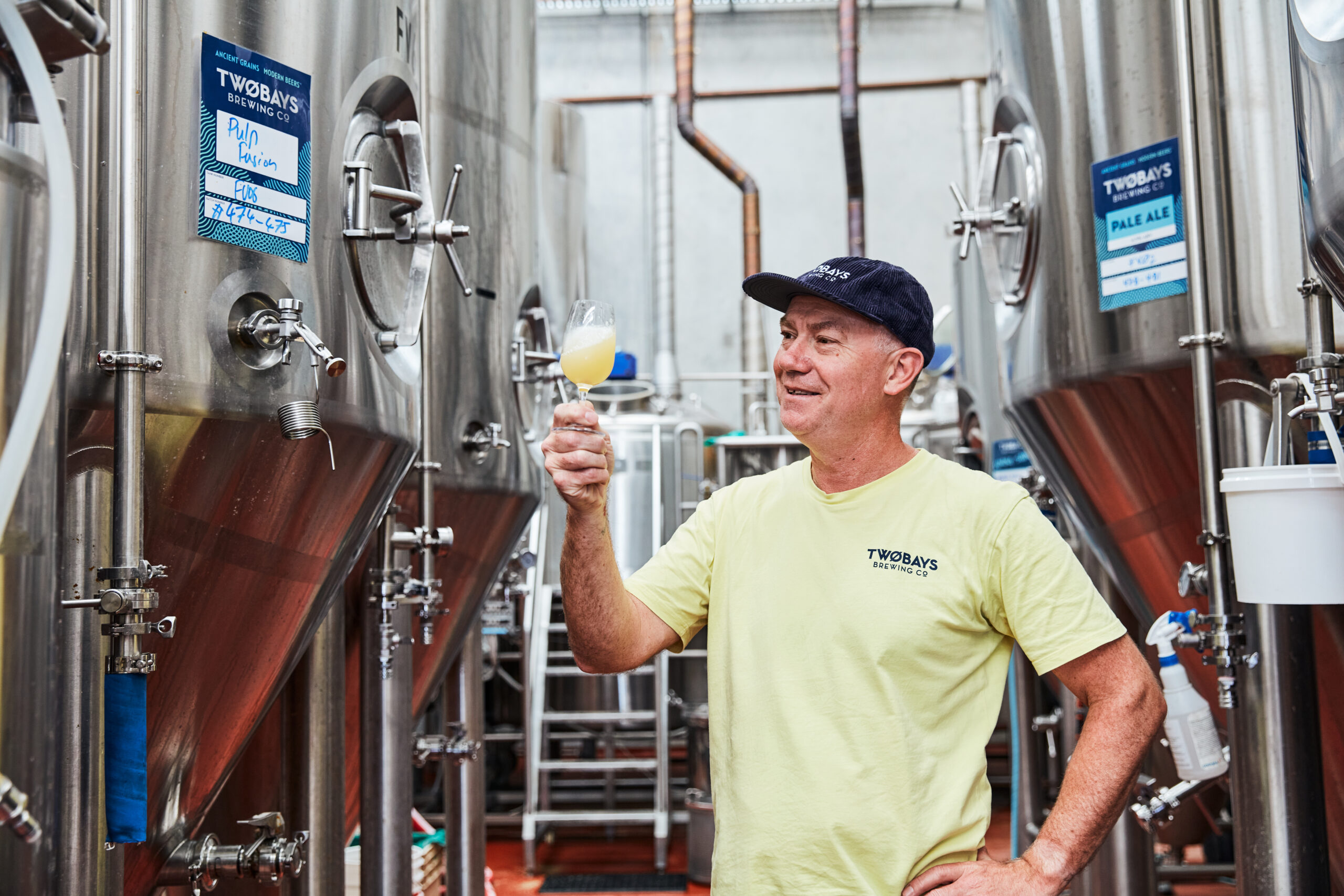
Founder Richard Jeffares, who started the brewery after he was diagnosed with coeliac disease in 2015, loves seeing gluten-free beer gaining the awareness that gluten-free food has had for decades.
Richard Jeffares
Jeffares might sound like a familiar to name to beer fans — that’s probably due to his brother Steve, co-founder of The Local Taphouse in St Kilda, Stomping Ground in Collingwood and the GABS festival.
“Steve got me into the craft beer side of things when he first opened The Local, and when I got diagnosed with coeliac disease, and beer kind of got taken away from me, he said, ‘why don’t you start a gluten-free brewery?’.
“I credit him for getting me into craft beer, and I credit him for getting me into the brewing industry although I’ve cursed him a few times as well.”
Jeffares learned he was coeliac after donating blood.
“They told me I was low in a protein called albumin and said ‘go and find out why, and then you can come back and give blood’.”
A gastroscopy revealed the damage to the vili in his stomach, the little tentacles that absorb all the nutrients. “If you have coeliac disease and are eating gluten, then those villi die basically. Therefore you’re not absorbing nutrients and you can get quite sick. A lot of people when they stop having gluten, they can feel better in a matter of days. The stories I hear are amazing.”
Around 1-in-70 people in New Zealand have coeliac disease but a much higher number are gluten-free. Jeffares says Two Bays reaches beyond even the gluten-free market.
“A lot of our consumers are not coeliac, and they’re not even gluten-free. They just like our beer. They find it doesn’t make me get them as bloated. We certainly know our drinking audience is much bigger than gluten-avoiders.”
Jeffares estimates Two Bays can be found in 150-160 taprooms around Australia where it’s not competing with in-house beers “but it just allows people to bring their gluten-free friends along”.
Jeffares is familiar with New Zealand gluten-free beers and likes them, but he thinks Two Bays can provide stronger impact within the gluten-free community.
“I’ve drunk Kereru and Scott’s but I think the reality is that they’re marketing barley beers while happening to have a gluten-free … it’s a smaller part of what they do.
“I think the difference is that we have the marketing power to tell everybody where to go and get it.”
“We don’t try and say it’s going to taste the same as barley beer. We don’t want it to.”
Richard Jeffares
Jeffares wants to see gluten-free beer as widely available as GF food.
“Everybody understands that if you’re going to a venue, they’ve got to have gluten-free food. And certainly going around New Zealand as a consumer, it was very easy to feel safe to eat out.
“But nobody’s there knocking on their door telling them, ‘have you thought about putting a gluten-free beer in there for the consumer who wants a beer with their meal?’ We put as much work in trying to get it on the shelf as we do trying to tell the consumers where to go to pull it off the shelf.”
Having GF beer at venues and restaurants allows GF beer-lovers to have the same experiences as regular beer drinkers.
“It’s quite amazing the joy it brings to people being able to share a beer. And that’s the infectious part of it.
“And that’s kind of what we sell to venues — if you can provide that experience you’ve got that consumer. They’re going to make it a destination to go to if they can be the same as everybody else, have a beer and have a safe meal.”
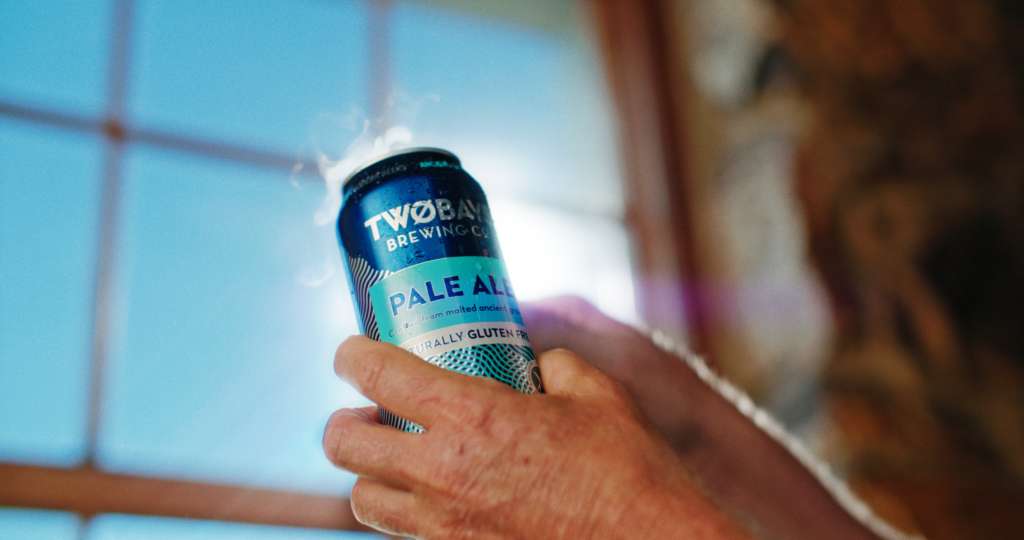
The entire Two Bays range is available online in New Zealand and Garage Project will distributing the Pale Ale and GFB Draft in the retail space.
“If people can pull a four-pack off the shelf and take it to a barbecue it’s just one less barrier. Right now, if want a gluten-free beer on Friday night you have to order it on a Monday.
“But if it’s a case of ‘I feel like a beer tonight’ then GP will hopefully give us that ability.”
I was intrigued by their stout and wondered how they made it.
Richard admits their main grain, millet, is hard to roast because the grains are so small they burn easily in a kiln, so they used kilned rice for colour and flavour.
“Our rice supplier has what he calls pitch rice, which is his dark roasted rice.
“There are about 15 or 16 different millet malts that we can choose but when they get to their darker roast it’s very acrid because the millet’s so small by the time you put it through the roaster you’re basically charring it. Whereas the rice, being a bigger grain, we can get nice colour and flavour through that without getting a charred, heavy smokiness.”
All the malts and rice are imported from the US. They use pea protein to help head retention.
Gluten-free beer is lighter in body that traditional beer because of the grains but that doesn’t faze Jeffares, who said consumers prefer for lighter bodied beer now, even in craft.
“I describe it as the pinot noir of the beer world because it has that lighter mouthfeel. It is very difficult to make, just like pinot noir. You’re starting with tiny grains, just like pinot noir grapes are small. But you can still make a brilliant product with it.
“We don’t try and say it’s going to taste the same as barley beer. We don’t want it to.”
Michael Donaldson is the publisher and editor of Pursuit of Hoppiness. He is the author of Beer Nation, The Art & Heart of Kiwi Beer; The Big Book of Home…
We use cookies to ensure that we give you the best experience on our website. If you continue to use this site we will assume that you are happy with it.