Champion hop grower Aeron Moleta believes the recent dip in demand for hops has bottomed out and feels positive for the future.
“It’s going in the right direction,” Aeron tells Pursuit of Hoppiness just ahead of this year’s harvest.
“I think the of consensus seems to be that last year was rock bottom, hopefully. It’s picked up a bit since last year and I think everything that NZ Hops are doing to improve quality is certainly giving us an advantage there.”
The Moleta family, who own Kotare Hops, are relatively new to hop-growing with the just-completed season their ninth. But they’ve won NZ Hops Ltd’s champion grower title three times — in 2021, 2022 and again last year.
Aeron says it’s a combination of factors that help them produce such high quality of hops — and the fact they’re new to the game is part of that because all the equipment they purchased was new and state of the art.
“Quality is the key, and for us it’s quality over quantity. That’s about picking the varieties exactly when they should be picked. And then all the other side of it is it’s our compliance side with NZ Hops.
“A big part of that is our pre-harvest audit. They come and inspect all the machinery in our shed, and everything’s got to be super clean … there’s a million things on that list.
“And then when it comes down to harvesting it’s when you pick the hops to minimise damage. If you go too early, they don’t pick well, and you end up having to pick them physically hard with the machine, and you end up damaging them. If you leave them too late, they’re more likely to just to break up and disintegrate.
“The higher the breakage the more lupulin you lose — and everything you want is in that lupulin, all your oils and your aromas and everything.
“Our drying process too is important. The kiln we bought when we started was a state-of-the-art system. It’s very efficient and very quick. I would say the faster you can dry hops without going over 60 degrees, the more quality you seem to retain.
“Whereas if you spend hours and hours and hours, it’s almost as if they’re stewing, and if you lose moisture too quickly, you’re going to change the hops a little bit. So that’s certainly one thing we feel we’re pretty good at.”
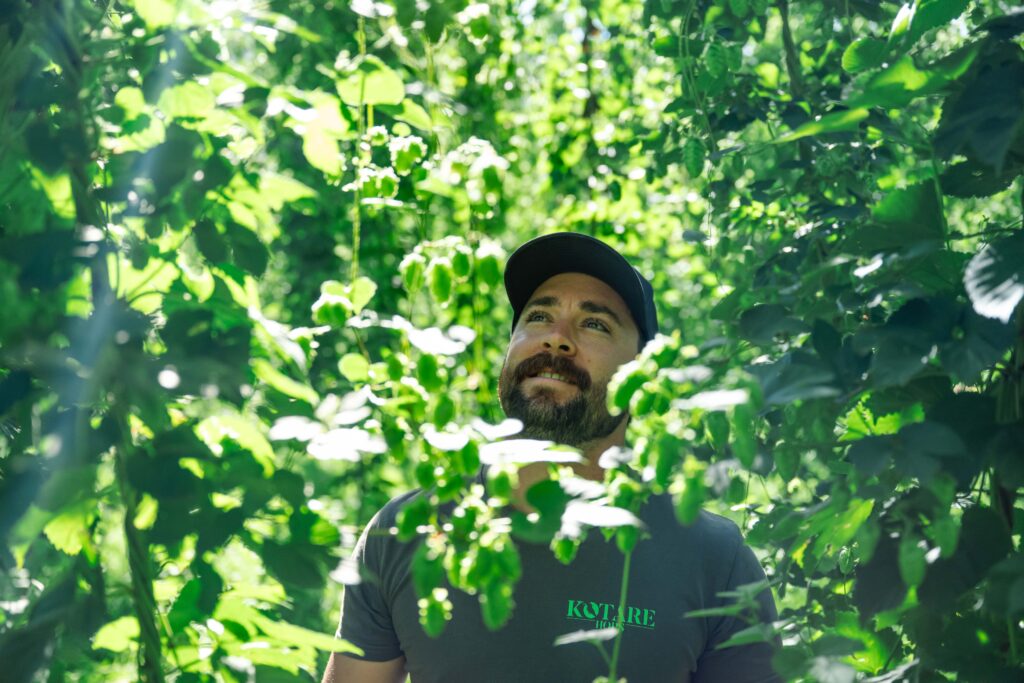
The Moleta family came to hops in a roundabout way.
The family are sheep farmers from the Marlborough Sounds but around 10 years ago Aeron’s father Noel was looking for land in the Tasman region as another option.
At the time, what is now Freestyle Hops, was on the market.
“Dad had been looking to buy some new land for several years and this property came up. Due to a drop in the milk price, we picked this place up for a good price. We weren’t exactly sure what we were going to run here — at the time he was probably thinking more sheep.
“And then dad saw what’s now Freestyle Hops for sale, and it was a huge price for a pretty small property. He was like, ‘what’s that?’.”
With his interest piqued Noel went down the road to visit Colin Oldham at his multi-generational New Hoplands farm.
“Colin encouraged us because at the time they were needing more growers.”
Aeron was living in Germany at the time working as a climbing arborist. Knowing nothing about hops he was charged with checking out hop picking machines and kilns. The family spent about $3 million on brand new equipment.
“It was a big, big financial call to go all out and to not buy second hand or to try experimenting by building stuff ourselves.”
They bought a modern “plug-and-play set of machinery” from Germany but were helped by the traditions and experience already in place around them.
“You can have all the best equipment in the world, but if you’re a little bit slack and you don’t focus on what you’re doing, then it’s still not going to come out right. The advice we got from the other NZ Hops co-op members who have been doing this for up to four generations was just brilliant.
“Honestly, one of my favourite things about being a hop grower is the relationship we have with the other growers. There’s so many mistakes that we didn’t need to make because of this advice that they’ve given us.”
Kotare Hops grows around dozen varieties, each in relatively small blocks to maximise the harvest efficiency.
“I’d love just to have two varieties, but you’re not going to be able to pick them in time.
“We pick, on average, about a hectare a day with our setup and that’s why we grow so many varieties, to balance that picking window and pick them right when they really should be picked.”
Aeron’s favourite hop is Taiheke as it’s the easiest to grow and pick. “But Superdelic’s right up there,” he adds.
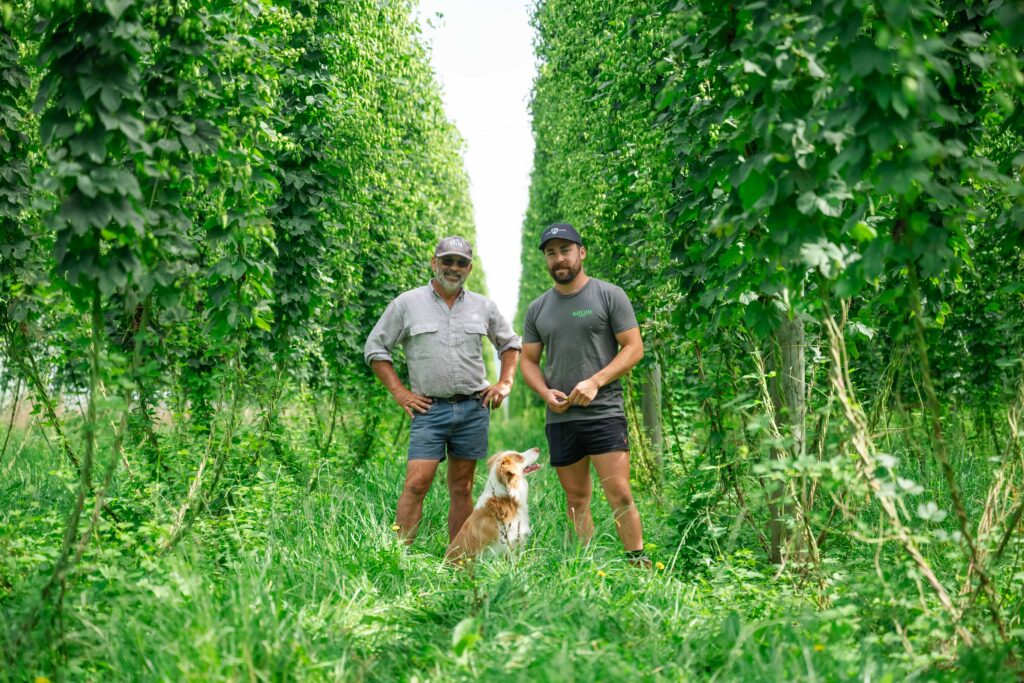
I finish by asking Aeron if his dad’s happy with his investment almost 10 years in?
“Yeah, I think so. It has been a good year for lamb prices, but the hops are now, financially, the biggest part of our family business.”
And it’s very much a family affair.
“We’re all still very much involved. My sister Laura lives on the neighbouring property, and she runs the livestock on this property.
“My brother, Braden, who’s based on the farm in the Sounds, he’s a mechanical engineer, and so he comes out and does the mechanical jobs and helps here. And my older brother, Nick, he doesn’t work for the family business. He’s based in Auckland, but he’s a chemical process engineer, and he comes down and helps with some jobs as well.”