A couple of days after being named New Zealand’s champion brewery, Daryl Bryant of Karamu Barrelworks dropped off 40 dozen bottles of his wild-fermented beer to online seller The Beer Cellar — the best place to shop if you’re looking for one of his unique bottles, complete with a cork held in place by a piece of knotted string.
In an era where most craft breweries have their own webstores, Karamu Barrelworks doesn’t even have a web page — Instagram is the main place you’ll find them in the digital landscape.
“I’m encouraging people to use the Beer Cellar,” says Daryl. “They’re close to me and so it’s so much easier for me than having a webstore.
“I’ve got too much on my plate as it is, so to be sending out beer directly from here would be another burden. The Beer Cellar have a wonderful selection and I really want to support them.”
The award-winning Karamu fruited sours come in bottles that feature a hand-knotted string around the cork.
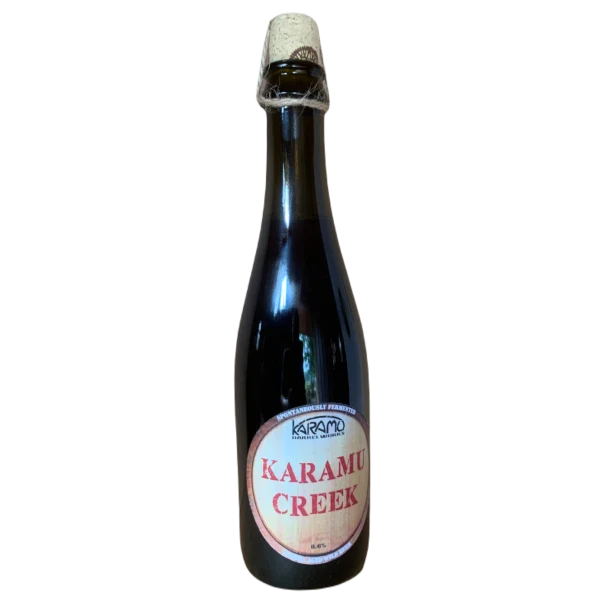
“It’s all done by hand — it’s a very slow process. I couldn’t afford a cork and cage machine and that’s why I came up with that knot. I’d seen it in books and people in the old days tied in champagne corks with knots.
“I knew it was feasible and while it takes a few seconds for each bottle, it all adds up — I’ve done several thousand of them in the last year.”
Being hard to find is one thing, producing a super-niche style is another and together that make it hard to earn money, with Daryl admitting his business has only recently started to turn a profit.
“The New Zealand audience is quite small … well, the global audience is small.”
That said, every time Karamu finds success, there’s a rush on the beers but despite a lot of publicity in the past two years (Karamu was named New Zealand’s champion microbrewery last year) he’s not about to expand beyond his annual production volume of 10,000 litres.
“This won’t change anything. I had to decide what my scale was going to be from the outset, because I built the barrel room around a certain size, so I picked 10,000 litres a year and I’m pretty well stuck with that. I could expand, but there’s really no point.”
A victory for the style
While Karamu’s crown as New Zealand’s champion brewery won’t change things at the small Waikato farm-house brewery, Daryl does hope it changes things for all of those who produce wild- and spontaneously-fermented beer.
“I think it’s great for the style. The biggest hurdle with these beers is that people don’t know what it’s about.
“As soon as they hear it’s a bit sour, they write it off. So, this win is great for the style. From my point of view, that’s going to be just as important as having my name there — the fact that the style is recognised.
This win is great for the style. From my point of view, that’s going to be just as important as having my name there — the fact that the style is recognised.
Daryl Bryant
“I’m really surprised, once you get it in front of customers, people that often don’t like beer … suddenly their eyes will light up and they’ll say, ‘oh, I didn’t realise that beer could taste like this’.
“But it’s just getting past that. It’s getting access to the customers that’s the problem.”
Daryl is also a big fan of calling his beer “wild” rather than “sour” as that seems to be a negative term. He makes the comparison with orange juice, noting that while it’s acidic no-one would call it sour juice.
Outside the Beer Cellar for bottles there are plenty of kegs of Karamu beer — “I’m open to anyone who wants to stock it,” Daryl adds.

In Hamilton there are two permanent Karamu taps at Brewaucracy thanks to the support of owner-brewer Greig McGill.
“When I popped up, Greig took me under his wing and he’s had two taps on there for years.”
Another local bar, Wonder Horse, has a couple of handpull taps that often feature Karamu beer.
Handpull lambic-style beer? I ask if it loses much of its effervescence.
“Oh, it’s almost flat. Completely still.”
Wonder Horse gets the best of Daryl’s barrels.
“I go around the barrel room regularly tasting stuff, and wherever the best beer is, I hang a little tag on it. The tag says ‘Alice’. I call the beer Alice. So Alice is the magic that moves from barrel to barrel. It varies from year to year but whichever barrel is Alice, they get it and it just goes on the hand pull.”
Auckland bars 16 Tun and Brewers Co-op often have Karamu taps as well.
Further afield, there’s a chance he might be exporting to China soon.
“I haven’t sold any there yet, but I did send up samples that were presented at a craft beer festival in Shanghai just a month or so ago and the woman who took them said there was great interest. But it’s not actually in front of the customers yet, so I can’t be sure.”

Daryl focuses mostly on fruited wild ales but he also does a regular saison that is aged in a chardonnay or gin barrels.
“I always have a saison available, as it’s my favourite style. I do a standard saison I call Tank 4, and when it goes into Chardonnay barrels, I just call it Tank 4 Barrel Edition. And some goes into a gin barrel, which I call Tank 4 Botanical Edition.
“There’s a couple of other beers, including Karamu Red, the Flanders Red-inspired beer that won a gold at the awards.”
Each of the fruited beers takes around two years to brew. He uses a recipe that’s 40% raw wheat and 60% malted barley, a turbid mash, aged hops, and a long boil before leaving it in a coolship overnight. The beer is then aged in oak barrels for at least a year before being refermented on the fruit of choice — cherries, peaches, apricots, grapes — for a number of months before conditioning.
We’d been misled in New Zealand
Daryl has been home brewing since he was a boy, starting with ginger beer.
“I’ve been brewing since I was a kid — I don’t know why I was particularly interested in it, I’ve always had lots of hobbies, and brewing was one of them. So I sort of brewed the usual stuff, ginger beer and cider and things like that, even as a kid. But once I got to university, it was just to make cheap beer.
“My first beer epiphany was in England. When I arrived there and discovered what real beer tasted like I was initially quite annoyed at how we’d been misled in New Zealand.
“Although I used to drink at university, if it wasn’t my own beer, I generally drank Steinlager Blue, but most of the rest of it was in hindsight, just an alcohol base with some syrup added. And when I got to England and tasted hops, I just thought, ‘gosh, this is wonderful’.”
Another moment came in San Francisco, but it wasn’t a super-hoppy West Coast IPA.
“It was around 2008 and I had a Berliner Weiss for the first time and that really set me on the path to the beers that I have now. I had no idea that you could have beer with sourness rather than bitterness.
“I came back home and it wasn’t long before I was spontaneously fermenting. I just had a 30 litre bucket and I left the lid off for a couple of days and then put the lid on. And then if nothing happened, I’d take the lid off again.
“Then I put it in a barrel — a 20 litre barrel to start and then a 60 litre barrel.”
An avid reader, he started studying Belgian beer and visited the home of lambic as soon as he could.
“I rushed to Belgium and really started getting into it, talking to other brewers and so on. I was just blown away with it and haven’t been able to put it down.”