Some years ago, I found myself wandering through St Clair in South Dunedin. I stopped to sit awhile taking in the view and taking off the weight. The roadside bench I perched upon was formed by a mini surfboard-shaped seat set upon a pair of sturdy legs. St Clair is a surf spot and at some point, someone had the bright idea of theming the suburb’s public seating. At the time I mused that we live in an age of theming. I think it started with pubs. A pub could no longer just be a pub, it had to be Irish, or sports, Spanish, Belgian or in far flung lands, Australian, with an honorary side serving of ‘Kiwi’ on ANZAC Day. Well perhaps that era of the theme pub is drawing to a close.
At the start of this year the Wellington Belgian Beer Café, Leuven, announced it was closing its doors after 25 years. Back in 2000, Lion started to brew Stella Artois under license and all of a sudden Belgian beer culture was in vogue. Leuven in Wellington and De Post in Auckland both opened, offering the full tourist-style Belgian beer experience with mussels, frits, draught Stella, Hoegaarden, Leffe and assorted bottled beers from the lowlands.
Since then two more cafes, The Occidental and De Fontein in Auckland followed. In 2004 Christchurch got Café Torenhof which limped on after the earthquakes before running out of steam in 2020. For a decade Rotorua had an independent offering in the form of Chambers / The Belgian Bar. My one experience here was sadly marred by our idiosyncratic Easter trading laws and featured a very stressed host, and existential arguments over the true nature of a “meal”.
Café Torenhof lives on in the way your great aunt does because you inherited her Welsh dresser and it sits in the corner of the living room. When the Christchurch café closed, its interior kit was sold to Craftwork in Oamaru. The polished wood panels and furniture of the standard Belgian beer café are manufactured in Belgium and sent out around the globe. Torenhof’s “Welsh dresser” now forms part of the most authentic Belgian beer experience you will find in the country. Just don’t ask for a Stella.
A pub could no longer just be a pub, it had to be Irish, or sports, Spanish, Belgian or in far flung lands, Australian, with an honorary side serving of ‘Kiwi’ on ANZAC Day.
Perhaps a more enduring flavour of theme pub is that of the Irish pub. Guinness was first imported into NZ in 1851 and in 1964 the then still independent Tui Brewery started to brew it under license. NZ Breweries took over the license in 1967, and the Waikato Brewery produced it for a while before it was closed. Prior to the Christchurch earthquake the Canterbury Brewery brewed it. I toured the brewery in 2005 and a young brewer departed from the script and divulged more details he was meant to about how the black stuff is produced here. You might get the secrets out of me if you ply me with pints. Guinness is now being produced in Auckland at The Pride.
Just as with the Belgian interiors, the dark wood panels, plush stools, horse brasses, wall hung fiddles, warming pans and “Guinness is good for you!” posters, are all manufactured and ‘aged’ to a perfect patina in an assembly line and then exported out around the world to shopping centres in San Diago, airports in Hong Kong, and high streets in New Zealand.
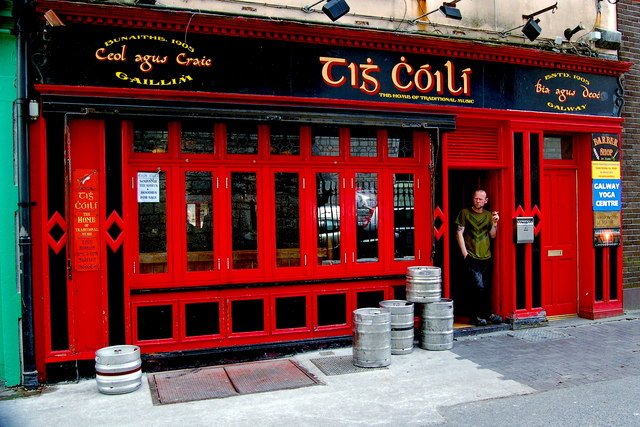
Wellington has lost most of its Irish pubs with JJ Murphys being the last establishment showing any dedication to the theme. Irish pubs are in better health around the rest of the country although it should be noted that, as perhaps the biggest global pub theme. there are a lot more of them to spare.
Perhaps the strangest theme pub Wellington has seen was a “Kiwi Bach” themed pub that grew where an English-themed pub once was. The absurdity of swapping out the horse brasses, tin Tetley’s Bitter wall hangings and Kronenberg fonts to replace them with paua shells, Top Twin photos and lamb burgers with beetroot was profound. The imperfections of the allusion come into stark focus when the pastiche is performed within the culture it is imitating.
While I suspect Leuven’s demise was an inevitable part of changing times and a changing city it’s hard not to be sad about its passing. It has been a fixture throughout my legal drinking life. The location for work drinks, leaving parties, quick halves between shopping missions, birthday pots of mussels and post-Cake Tin show refreshments. I remember wringing out my clothes in the gents after the monsoon doused David Bowie show in 2004 and then the taste of the chalice of Leffe Blonde afterwards.
Hopefully something vibrant and new goes into the site. However, the fact the former Avida site across the road remains empty is a bad omen. Avida being the bar which was a Spanish themed pub and before that it was the Black Harp, which was an Irish themed pub, and before that …