Their team might have been thrashed in the Super Rugby final but brewers from Chiefs’ country were the big winners at the NZ Beer Awards, turning the tables on their rivals from the capital by eight trophies to one.
And frankly, it could have been 10 to one if we play by the rules and include Taranaki’s Shining Peak even though rugby fans in that area are still staunchly connected to the Hurricanes.
The Waikato-Bay of Plenty region produced the champion in three categories: overall brewery (Karamu), medium brewery (Mount Brewing) and microbrewery (Neck Of The Woods). The region also earned five style trophies: two to Good George (Fog City, Frankton Bright IPA), two to Mount Brewing (Harley’s Irish Stout, The Trifecta NZ IPA) and another to Alchemy Street (Hot Box).
The sole style trophy headed to Hurricanes’ country was Parrotdog’s win with their limited release Red IPA.
Brian Watson from Good George, a stalwart of the region, acknowledged it was a defining moment for a growing beer region.
“Believe me, on the Saturday night of the awards there was me, Scotty Taylor and Ed Bolstad in Albar and we were like ‘wow, we’re in Chief’s country now’. We talked about the change in the landscape and how the craft brewing capital is now the Waikato-Bay of Plenty.
“I think Tauranga could be an emerging force in the industry, there’s some really good brewers over there, some really good brewing.”
NECK OF THE WOODS’ MEMORABLE WEEK
Watson was instrumental in pairing Reid Lidington with Scott Taylor at Neck Of The Woods.
Reid had worked as a production manager at Good George but moved to Tauranga to be nearer family. When Taylor was looking for a brewer, Watson introduced him to Lidington, who was working at a fish processing plant.
Taylor, who was the face of Deep Creek for many years before it went into liquidation, noted: “I’ve been incredibly fortunate in my career in brewing that I’ve been able to work with some of the industry’s best brewers, like Hamish Ward and Dylan Adams, who is now at Brothers Beer … and now Reid. He’s a very talented young man.”
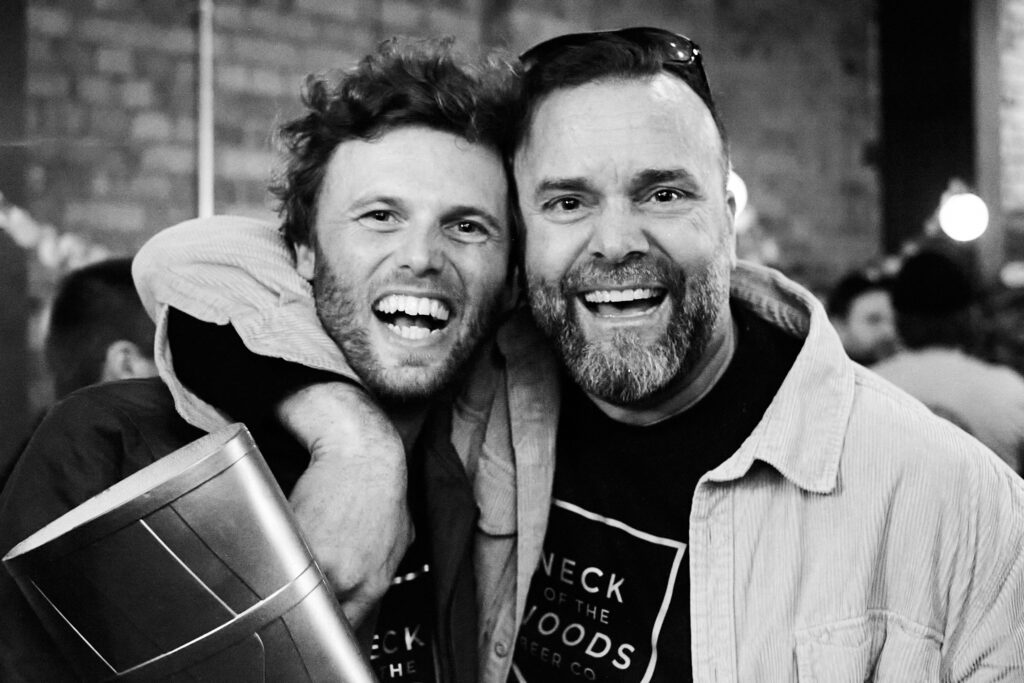
Taylor, who saw more than his share of success with Deep Creek, had an incredible six days in the last week of July, winning champion microbrewery and then taking out the Malthouse West Coast IPA Challenge with Kinky M.I.L.F (Man I Love Flamingos).
In the wake of Deep Creek’s liquidation and following the death of his mother, Taylor and his wife Debbie sold their Auckland home and the family moved to Papamoa.
He was joined in the venture by Virgil Meiller, who was previously general manager at The Barrel Room in Tauranga.
“After Deep Creek, to try to do something else was a massive decision and it took a monster effort to get it going.”
There’s a little bit of Deep Creek in some of the beers from Neck Of The Woods, notably Cobra Kai, which took out People’s Choice at the Smith’s NZIPA Challenge earlier this year.
“Cobra Kai was a take on Misty Miyagi. The biggest change was the ABV because we try not to make them too because we’re more of a brew pub and we want people to be able to drive and have a couple of beers. So instead of the 6.5% that Misty Miyagi was, ours is 5.8% but Misty Miyagi wasn’t a full actual New Zealand IPA so it’s actually the same hop profile as another beer called Sensei, but the name and then the visuals were all definitely inspired by Misty Miyagi.”
The other beer they riffed off was Deep Creek’s first ever brew — the cult classic brown IPA, Dusty Gringo.
“So we did Rusty Dingo — it’s the same hop profile as Dusty Gringo but again lower alcohol. I think Dusty was at 6.8% and this one is down about 5.6%.”
Rusty Dingo won a gold medal at the NZ Beer Awards.
TRIPLE CELEBRATION AT MOUNT BREWING
On a night where Emerson’s won two trophies for beers named after his late parents, George and Ingrid, Mount Brewing celebrated a trophy bearing the name of their co-owner Niall Harley.
Harley married into the brewery, his wife Briar the daughter of Mount Brewing founders Steve and Virginia Meikle.
Niall, an Irishman from Donegal, wanted the brewery to create their own version of Guinness.
“I remember saying to [brewer] Tom Ball a few years ago, I just want a beer like a Guinness, but with a wee bit more flavour in it.
“So Tom went off and did his magic, and he and [head brewer] Pawel Lewandowski have been working on it ever since, but I never thought it would do as well as it has.”
Constant improvement has been a mantra at Mount Brewing since the younger generation took over and Niall said the dream had always been to win champion medium brewery.
“At so many awards in the past we’ve got a lot of bronzes and a few silvers and not a lot of golds, we’ve always said ‘that’s never going to win us a champion brewery, we really need to be getting golds’.
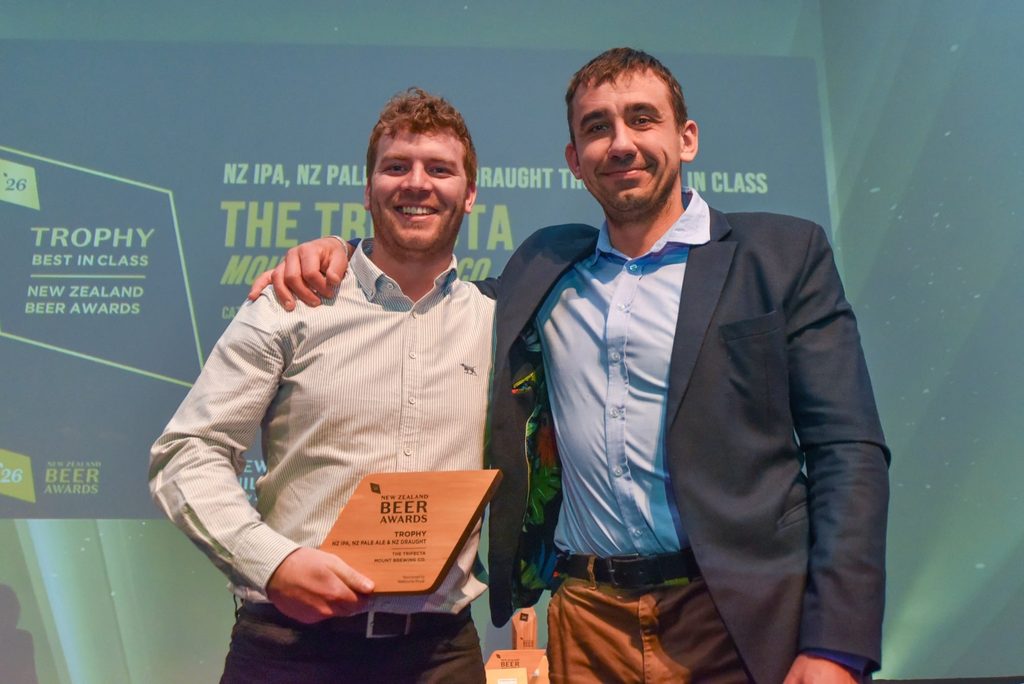
“We have dreamed of being champion medium brewery but in the brewery we don’t actually talk about that — but we do talk about striving to get more gold medals because if we do get gold medals then we’re in contention for the champion brewery, and yeah, this year we were lucky enough to get five golds and that led to an amazing achievement.”
A number of their golds were for core range beers, including Sea Beast IPA and Highline low carb hazy.
“Sea Beast is another recipe that Pawel’s been tweaking for years — and it was amazing to see that get a gold. A lot of us in the brewery drink that beer quite a bit and we’ve all been saying ‘man, the Sea Beast is tasting so good at the moment’.”
The triumph for Mount Brewing capped a year of multiple celebrations: they celebrated their 30th birthday and just a few weeks ago a third generation was born into the brewery with the arrival of Briar and Niall’s son Fiadhán (pronounced Fionn).
KARAMU — A WIN FOR THE STYLE
In an era where most craft breweries have their own webstores, Karamu Barrelworks doesn’t even have a web page — Instagram is the main place you’ll find them in the digital landscape.
So where do you find these amazing wild-fermented beers?
“I’m encouraging people to use the Beer Cellar,” says owner-brewer Daryl Bryant. “They’re close to me and so it’s so much easier for me than having a webstore. The Beer Cellar have a wonderful selection and I really want to support them.”
The intriguing Karamu fruited sours are unique in more ways than one — they come in bottles featuring a hand-knotted string around the cork.
“It’s all done by hand — it’s a very slow process,” Daryl says. I couldn’t afford a cork and cage machine and that’s why I came up with that knot. I’d seen it in books and people in the old days tied in champagne corks with knots.
“I knew it was feasible and while it takes a few seconds for each bottle, it all adds up — I’ve done several thousand of them in the last year.”
The time-consuming packaging is all part of Karamu’s style — you could call it slow beer. Everything takes time, with most of the beers taking up to three years to mature.

And the brewery is also limited to set size: just 10,000 litres because when Daryl built his brewing shed, that was the space he dedicated to the barrels.
“I had to decide what my scale was going to be from the outset, because I built the barrel room around a certain size. I picked 10,000 litres a year and I’m pretty well stuck with that. I could expand, but there’s really no point.”
While Karamu’s crown as New Zealand’s champion brewery won’t change things at the small Waikato farm-house brewery, Daryl does hope it changes things for all of those who produce wild- and spontaneously-fermented beer.
“I think it’s great for the style. The biggest hurdle with these beers is that people don’t know what it’s about.
“As soon as they hear it’s a bit sour, they write it off. So, this win is great for the style. From my point of view, that’s going to be just as important as having my name there — the fact that the style is recognised.
“I’m really surprised, once you get it in front of customers, people that often don’t like beer … suddenly their eyes will light up and they’ll say, ‘oh, I didn’t realise that beer could taste like this’.
“But it’s just getting past that. It’s getting access to the customers that’s the problem.”
Daryl is also a big fan of calling his beer “wild” rather than “sour” as that seems to be a negative term. He makes the comparison with orange juice, noting that while it’s acidic no-one would call it sour juice.
Outside the Beer Cellar for bottles there are plenty of kegs of Karamu beer — “I’m open to anyone who wants to stock it,” Daryl adds.