This is the second chapter in a series dedicated to breweries that have opened up since the Covid-19 pandemic. The past five years have been tough for those in the brewing industry. The data is there: higher costs, lower consumer spend, alternative drinks. All are eating into beer’s share of the beverage market. Despite the doom and gloom a number of breweries have started in the past five years. In this series we visit six from the length and breadth of the country. They are all slightly different but if there was one common denominator it’s that they’re all trying to control their own destiny in one way or another.
Coromandel Town Supply — Opened February 2025
I’m quite chuffed to learn from Tony Blackett that Pursuit of Hoppiness was critical in his decision-making when he set up Coromandel Town Supply.
A long-time home brewer, Tony had worked for Greenpeace in the Netherlands as a fundraising consultant for India, Russia and Northern Europe. That was followed by a stint in the Chatham Islands as the chief executive for the Hokotehi Moriori Trust, the organisation that represents the indigenous people of Rēkohu and Rangihaute on the Chatham Islands and other Pacific areas.
Coming back from that remote spot, the idea of city life didn’t appeal, so Tony and his wife bought a house bus and drove around the upper North Island.
“And when we got to Coromandel we went, ‘oh, that’s right we quite like this place’. We had lived here years ago and have friends here.”
With his corporate life behind him, Tony decided it was time to live the brewing dream with Coromandel Town Supply.
That’s where Pursuit of Hoppiness comes in.
“It’s helped me understand the state of the industry, whether there was an opportunity to make a living in brewing beer or not. And if so, where, how and what that might look like. How could it be resilient and effective? Over the years, I’ve built a repertoire of thinking, I guess, around your articles and those areas in particular.
“Also looking at trends and patterns, particularly in commentary in the areas of the magazine where you talk about the state of the beer industry, or what’s gone wrong for breweries, which I guess there’s been rather more of that than we would like.
“I was also interested in the sort of thinking people brought to the challenge of brewing and what people were getting out the other end of it. Sometimes I was reading with wonder at some of the weird and wonderful brews that people seem to get into, some of that leaves me a bit dumbfounded.
“But what I essentially picked up from that material was that an awful lot of the more recent brewery failures have occurred through mistimed expansion.
“And it’s no fault of the business owners themselves. They were largely following accepted practice in terms of borrowing for expansion. But then along came Covid and the interest rate spike and the drop in demand — no one was to know these things. And it knocked so many of those businesses over.
“So, we’ve come into it partly with that thinking in mind, but also, I remember my grandfather’s approach to business.
“He was a dairy farmer, and he had what today would be thought of as an uneconomically small herd. But he had no borrowing and I’ve sort of thought to myself, well I want to make one or two or three wages out of a small-scale business with very little overhead, very little staffing costs and no interest costs.
“That way we can ride out quiet times and be there and when it’s busy and do well enough. So low overheads, small scale, local focus, concentrating on quality rather than quantity and building a customer base over time.”
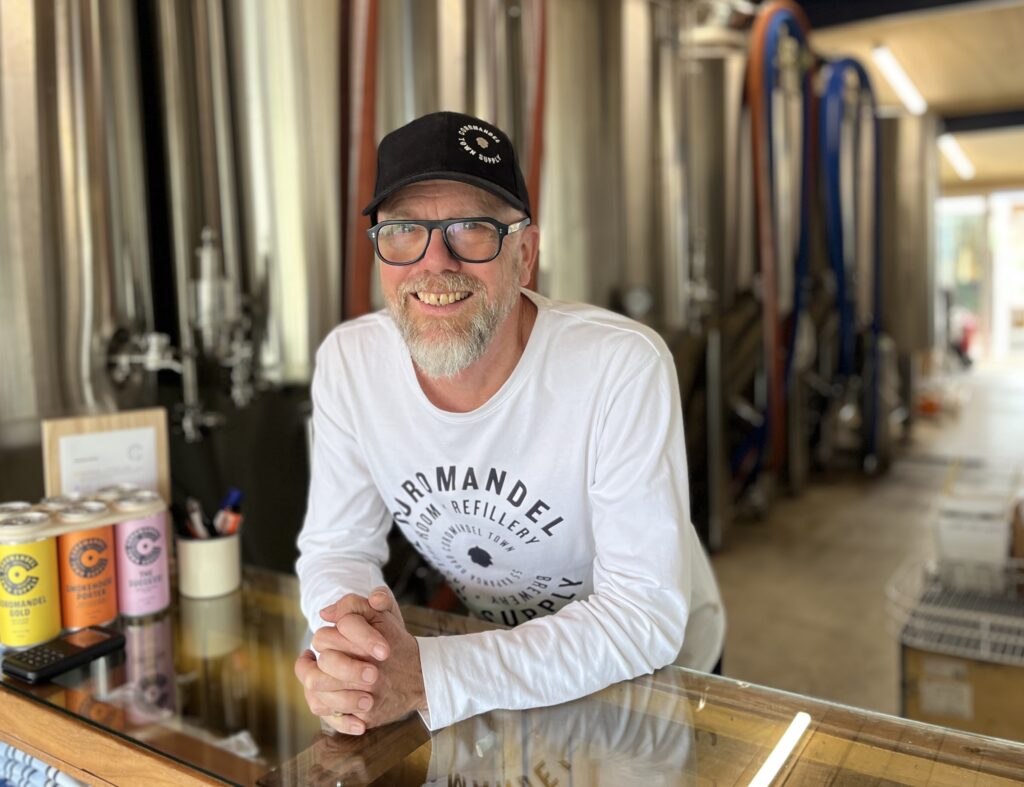
Brewing on a 1000-litre kit he’s also concentrating on quality over quantity and slowly embedding his brewery in the community.
Part of his due diligence was finding out if two nearby local bars — Peppertree, Star & Garter — would support him.
“They have both put a couple of taps on for us, They’re with DB and they went into bat for us with DB.”
As a result Coromandel Town Supply are the only non-DB product in either venue, which is a great outcome for everyone (and kudos to DB).
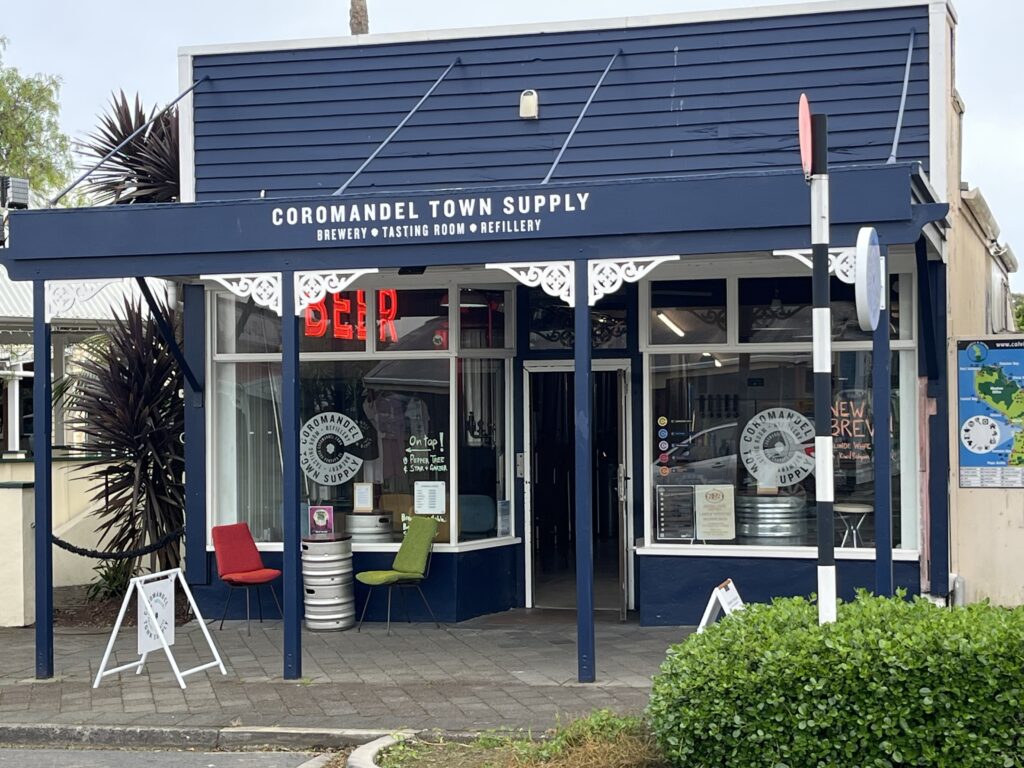
He also had some luck with the location. Initially he was looking away from the town but when the old butcher’s shop in the main street became available, he could see the upside in terms of visibility.
“Before this building came up, we were imagining finding and converting an old woolshed or something like that and being an off-main-street brewery, developing a brand and marketing that.
We could see that some sexy stainless steel lined up in a row on the main street in a little village like Coromandel Town could have kind of like a working sculptural element to it.
Tony Blackett
“When this building came up, we could see that some sexy stainless steel lined up in a row on the main street in a little village like Coromandel Town could have kind of like a working sculptural element to it, a point of interest.
“And it is working like that. We get people walking down the street who stop at the door and exclaim, ‘wow’. It is a point of interest in town. Ands local when they’ve got family visiting, they’ll routinely come down and bring their guests to sort of show off the new thing in town.
“I don’t know how many impromptu brewery tours I’ve done. It works well from that point of view and for a brand build and also it works for somebody of my vintage because I struggle to find enthusiasm for digital marketing and such like.
“The walk-by, drive-by traffic then leads one thing or another and that’s how some of the bottle stores are finding us, how the restaurants are calling and asking about us and that’s sort of where our business has come from, our presence on the street, I would say.”
While Tony wanted to stay small, he also wanted to can his beer. Not to try to crack into supermarkets on a large scale, but to reach the variety of small outlets around the wider area.
“There’s an awful lot of smaller establishments around the peninsula where they don’t have taps, don’t have facilities for kegs.
“And so being able to get there in cans was important.”
The canner, Tony confesses, has been “the most difficult piece of kit in the whole place”.
“May lack of experience with it has let us down a little bit. It’s the one area where we’ve copped a little bit of brand damage with some cans going out that weren’t quite right. But I think I’ve got to the bottom of that now.”
Tony has other small regrets, mainly buying more equipment than he needed.
“I got one or two things that, in retrospect, I didn’t need and I probably haven’t got enough cool room space.”
A clean-in-place cart is one thing he doesn’t use while a hop rocket has been a struggle to use effectively.
The brew kit, however, he’s very happy with. He spent a lot of time travelling to China to inspect breweries first-hand before buying. He was determined to get the best possible quality within his budget.
“One of the key things I learned from my home brewing experience was the value of equipment that’s designed and built by people who know what they’re doing. As compared to trying to put it together yourself unless you happen to be an engineer.
“I did the old search on Alibaba and got a deluge of material which I sifted through to create shortlist of about six. And for the price of a trip over there, I felt it was worthwhile having a look, and I was very pleased I did. Interestingly, price wasn’t really an indication of quality.
“The supplier I went with [Rainbow Engineering] was very much middle of the road in terms of pricing, but I’m very happy with the equipment and engineering types who come into the brewery often comment on the quality of the welding that they can see and that kind of thing.”
Heading into his first summer, Tony admitted he probably underestimated demand in an area that grows dramatically in the warmer months — and he’s seeing a lot of demand for this Coromandel Gold pilsner.
“Coromandel Gold is largely modelled on Emerson’s Pilsner in terms being an accessible beer with a little bit of character and it’s working well for us.”